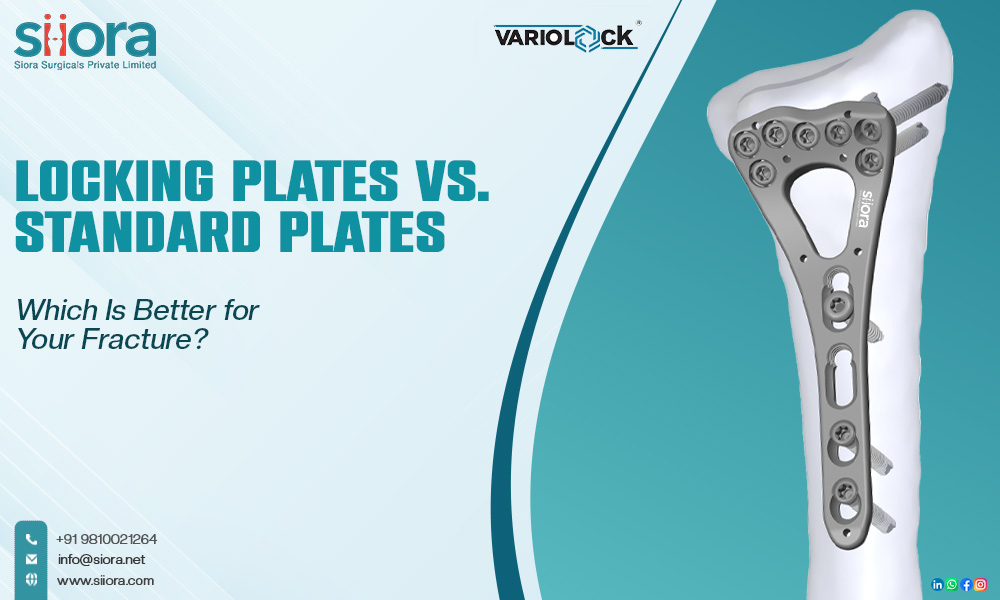
Fractures could be serious enough that they may force you for a complete rest for months. Hence, they require prompt yet right treatment to ensure better recovery. For serious fractures, orthopedic surgeons often use plates—thin metal supports fixed onto the bone with screws. But here’s the real debate: should it be a standard plate or a locking plate, like variable angle locking plate? Both have their place in modern trauma care, but the differences between them can decide how fast and how well you heal.
The Old Reliable: Standard Plates
Standard plates have been around for decades. The idea is simple enough: place the plate over the broken bone, insert screws, and pull everything tight. This compression holds the fractured pieces together so the bone can heal as one.
When the bone is strong—say in a young patient with healthy bone stock—these plates usually get the job done. They’re straightforward, widely used, and less expensive. Many patients recover fully with nothing more than a well-placed conventional plate.
But there’s a catch. Standard plates depend almost entirely on the grip between screw and bone. If the bone is brittle, like in an older patient with osteoporosis, or if the fracture is messy with several fragments, that grip may not hold. Screws can loosen. Plates can shift. And when that happens, alignment suffers, healing slows, and sometimes a second surgery becomes necessary.
The Newer Player: Locking Plates
Locking plates were designed to overcome those weaknesses. They look similar but work a little differently. Instead of just pressing the plate against the bone, these plates let the screws lock directly into the plate. Imagine snapping puzzle pieces together—once they’re in, they don’t wiggle or slide out.
This creates a fixed-angle structure that behaves more like an external scaffold inside the body. It doesn’t rely as much on the strength of the bone itself. That’s why locking plates are often a surgeon’s first choice for:
- Bones weakened by age or disease.
- Shattered fractures where tiny bone fragments can’t be secured with simple compression.
- Fractures close to joints where precise alignment is non-negotiable.
In these tough cases, locking plates keep everything in place while the body does what it’s designed to do—heal.
Which One Is Right for You?
The answer isn’t as simple as “locking plates are always better.” For some patients, the old-school standard plate is still the smarter move.
- A young athlete with a single, clean fracture? A standard plate could heal them just fine, and it’s easier on the wallet.
- An older patient with fragile bone? A locking plate offers more peace of mind.
- A multi-fragment injury from a road accident? Here again, locking plates usually take the lead.
So the decision depends not just on the implant but on you—your age, your bone quality, and the specifics of the fracture. In other words, it’s personalized medicine at work.
Looking at Pros and Cons
Standard Plates
- Trusted, cost-effective, simple to apply
- Best for strong bone with simple breaks
- Risk of failure if screws loosen
Locking Plates
- Provide rigid stability even in weak bone
- Designed for complex or joint-level fractures
- More costly but often more reliable
The Bigger Picture
Orthopaedic implants don’t heal bones—your body does. Plates, whether standard or locking, are just tools to hold everything steady in the meantime. What really makes the difference is how well the fracture was aligned, how carefully the surgery was performed, and how disciplined the recovery process is afterward.
So if you’re staring at an X-ray of your broken bone and wondering which implant you’ll end up with, don’t think of it as one being “good” and the other being “bad.” Both standard and locking plates have their rightful place in fixing fractures. The key is getting the right one for your situation—and that’s a conversation worth having with your surgeon.
 Siora Surgicals Pvt. Ltd.