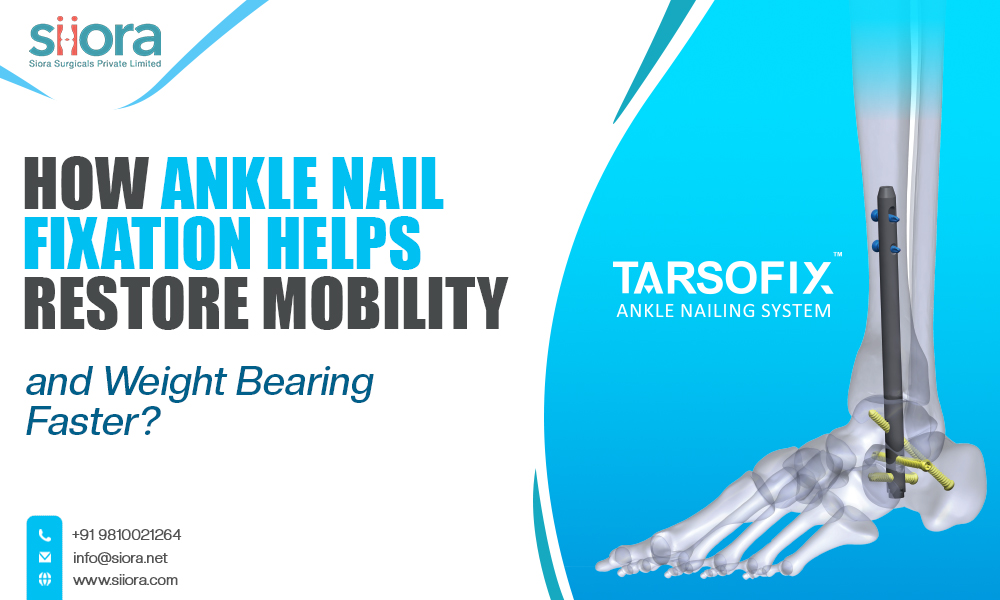
When you suffer a severe ankle fracture—one where the bottom of your shin bone (tibia) is shattered—your world grinds to a halt. The immediate goal is to fix the bone, but the real goal is to get back on your feet and back to your life. The speed of your recovery is directly tied to how quickly you can start bearing weight and moving again. For many of these complex injuries, surgeons are turning to a powerful tool that gives patients a critical head start: the ankle nail.
The Internal Powerhouse: A Different Approach to Fixation
When most people think of fixing a broken bone, they picture a metal plate screwed to the outside of it. An ankle nail, or intramedullary nail, is a totally different philosophy. Instead of a brace on the outside of the bone, think of it as a solid column of rebar going right down the middle. This strong metal rod is inserted down the hollow canal of the tibia, acting as a super-strong internal splint. Screws at the top and bottom lock it in place, creating a stable construct from the inside out. This “inside-out” approach is the key to its ability to get you moving faster.
The Stability Advantage: A Lesson in Biomechanics
Why is a nail so strong? It comes down to physics. A plate sits on the side of the bone, bearing the load like a bracket on a shelf. It works, but all the stress is on one side. A nail, sitting in the center of the bone, is a “load-sharing” device. It works with the bone, distributing your body weight and the forces of walking along the natural mechanical axis of your leg. This makes it incredibly strong and resistant to the bending forces that could cause a plate to fail.
This superior biomechanical stability gives the surgeon immense confidence in the repair. And that confidence is passed directly on to you.
Why a Stronger Fix Means Standing Sooner?
Here’s the simple truth: your surgeon’s weight-bearing instructions are based on how stable your fracture is. With a less stable fix, they’ll tell you to stay off your foot completely for six weeks or more. They are protecting the hardware from failing under your body weight.
But with the rock-solid stability of an ankle nail, the game changes. Because the construct is so strong, surgeons can often give you the green light to start putting some weight on your foot much, much sooner. Instead of weeks of being strictly non-weight-bearing, you might be allowed to do “toe-touch” or “partial” weight-bearing almost immediately. This is a massive head start. Every day you can put weight on your leg is a day you are fighting off muscle loss and retraining your body to walk.
Less Trauma, Better Mobility
Ankle nail surgery is also often kinder to the surrounding soft tissues. Fixing a fracture with a large plate requires a long incision and stripping muscle off the bone, which causes significant swelling and pain. Ankle nailing is done through a few small, strategically placed incisions, often far away from the main injury site.
Less surgical trauma means less post-operative pain and swelling. A less swollen, less painful ankle is one that you can start moving sooner. In those first few crucial physical therapy sessions, you’ll be able to work on your range of motion more effectively, paving the way for more advanced exercises down the line.
The Bottom Line: A Head Start on Your Recovery Marathon
Recovering from a major ankle fracture is a marathon, not a sprint. But an ankle nail gives you a running start. By providing a biomechanically superior, stable fix that is also less traumatic to the soft tissues, it allows for earlier weight-bearing and better early mobility. You can engage in meaningful rehab sooner, fight muscle atrophy more effectively, and start the process of walking again weeks ahead of schedule. For the toughest ankle fractures, it’s a powerful tool that doesn’t just fix the bone—it accelerates your return to life.
If you are looking for a world-class ankle nailing system and other trauma implants, contact Siora Surgicals Pvt. Ltd., a leading orthopedic implant manufacturer in India. The company will also be exhibiting at the WHX Dubai, booth HN7.A71, from 9-12 February 2026. Visit us to explore our advanced range of orthopedic devices and meet our experts.
 Siora Surgicals Pvt. Ltd.