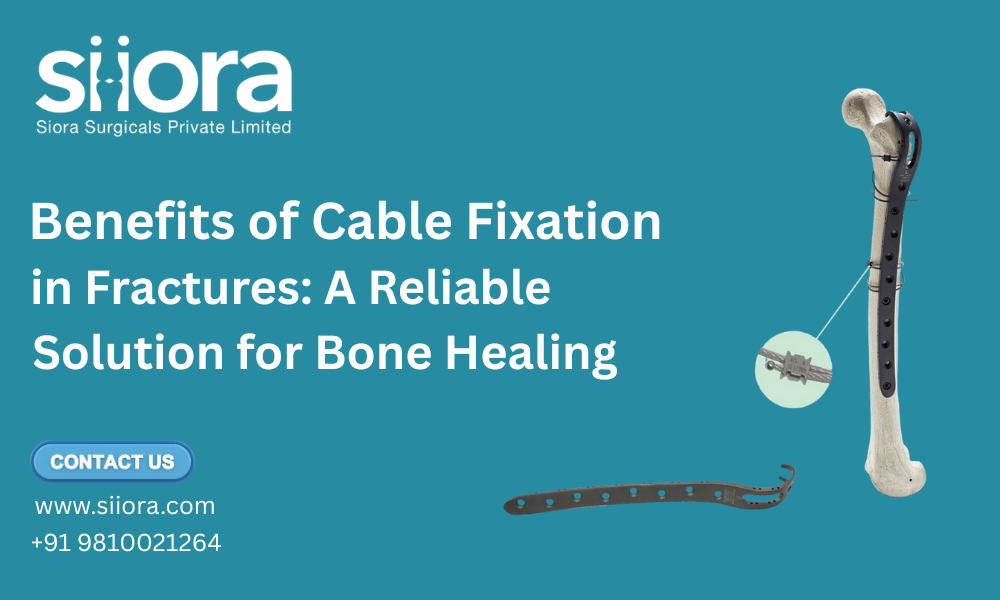
Fracture management has evolved significantly over the years, moving from simple immobilization to advanced fixation techniques that improve healing and restore function. Among these techniques, cable fixation has emerged as a dependable option for stabilizing complex fractures, especially in areas where traditional fixation methods may fall short. Whether used on its own or in combination with plates and screws, cable fixation plays a vital role in orthopedic surgery.
What Is Cable Fixation?
Cable fixation involves using flexible metallic cables, often made of stainless steel or titanium, to encircle and stabilize fractured bone segments. These cables are tightened to provide strong compression at the fracture site, keeping bone fragments aligned during the healing process. They are especially helpful in areas with complex anatomy, like the proximal humerus, pelvis, or around joint replacements, where achieving stability with screws or plates alone can be challenging.
Why Choose Cable Fixation?
Cable fixation offers several distinct advantages over other methods:
- Enhanced Stability in Complex Fractures
Some fractures are not straightforward. Bones can shatter into multiple fragments or involve irregular shapes that make traditional screw or plate fixation difficult. Cable fixation allows surgeons to contour around these shapes, holding the bone securely without needing to drill through fragile fragments.
- Preservation of Bone Integrity
Unlike screws, which require drilling into bone, cables wrap around the bone surface, minimizing further damage to already weakened bone tissue. This is particularly valuable in osteoporotic patients or revision surgeries where bone stock is compromised.
- Versatility in Application
Cables can be used alone or in combination with plates, screws, or prosthetic implants. In joint replacement surgeries, for instance, cables help secure bone fragments around implants, reducing the risk of instability and loosening.
- Promotes Early Mobilization
A stable fracture site means patients can often begin gentle movement and rehabilitation sooner. Early mobilization not only speeds up functional recovery but also helps reduce complications like stiffness, blood clots, and muscle atrophy.
- Durability and Load Sharing
The metal wires can handle a lot of stress, so they are great for bones that have to support a lot of weight, like the femur. They help share the mechanical load with other fixation devices, reducing stress on any single component and improving overall construct longevity.
Clinical Scenarios Where Cable Fixation Excels
Cable fixation is especially beneficial in:
- Periprosthetic fractures: These occur around joint implants, where traditional fixation may be limited.
- Comminuted fractures: When bones are broken into multiple pieces, cables provide a practical way to hold everything in place.
- Revision surgeries: In cases where bone quality is poor, cables help reinforce other fixation techniques.
Patient-Centered Outcomes
For patients, the biggest benefits of cable fixation are improved healing rates, less post-operative pain from secure stabilization, and a reduced risk of complications like malunion (improper healing) or nonunion (failure to heal). Faster recovery and a quicker return to daily activities are major advantages that improve quality of life after surgery.
Final Thoughts
Cable fixation is more than simply a way to do surgery; it’s a proven way to mend hard fractures that need more support. Its ability to provide secure fixation without significantly damaging bone makes it a preferred choice in many complex orthopedic cases. As technology advances, cable systems are becoming even more refined, offering surgeons better tools and patients better outcomes.If you are looking to become a distributor of orthopedic implants in Dubai, contact Siora Surgicals Pvt. Ltd., one of the top medical implant manufacturers in Saudi Arabia.
 Siora Surgicals Pvt. Ltd.